
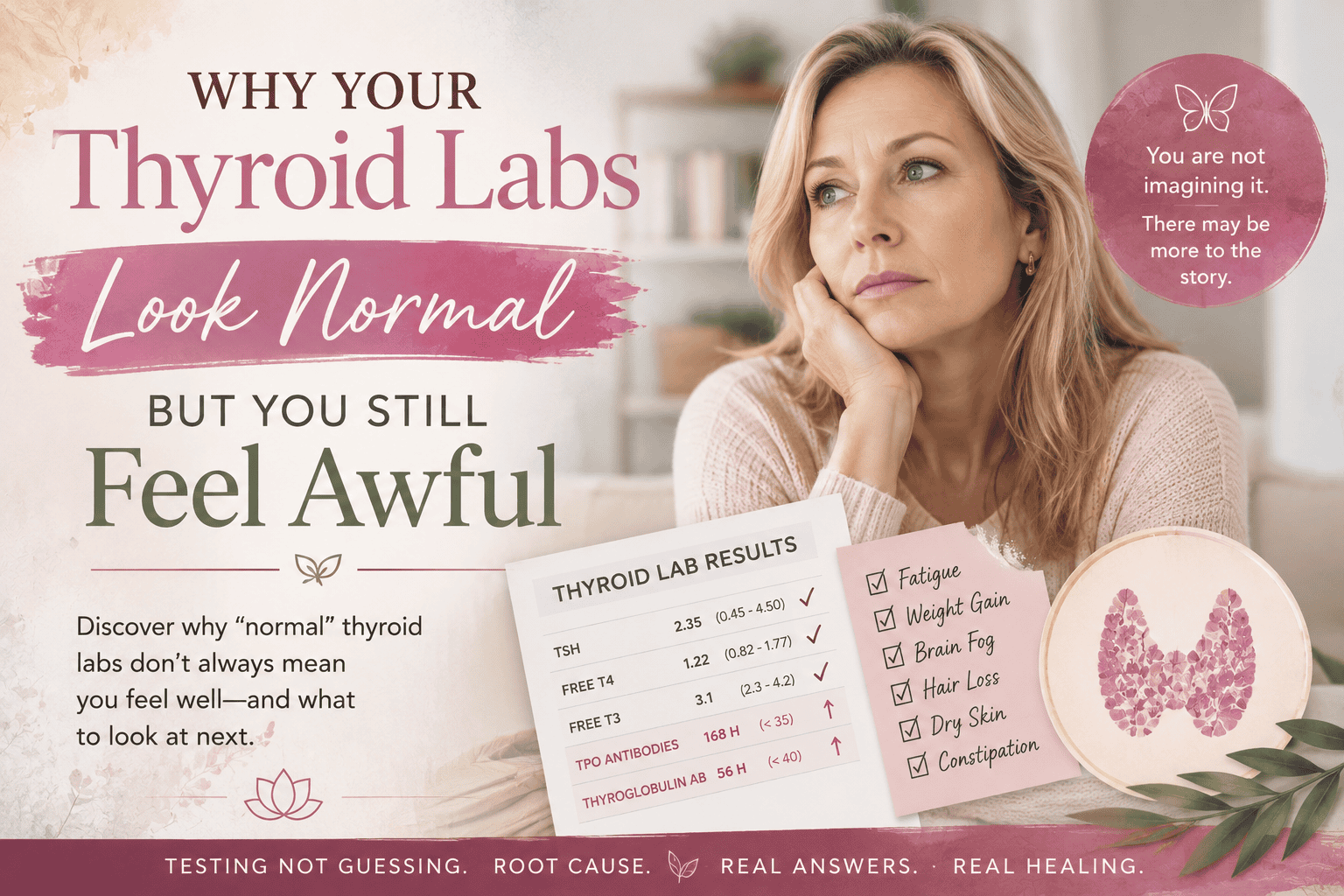
Why Your Thyroid Labs Look Normal But You Still Feel Awful
“Your thyroid labs are normal.”
If you have heard those words but walked out of the office thinking, Then why do I feel so awful?, this article is for you.
Maybe you are exhausted even after sleeping. Your hair is thinning. Your skin has become dry. You are constipated, cold, foggy, puffy, or gaining weight even though you haven’t dramatically changed the way you eat.
For women over 40, it can become even more confusing. Menopause enters the picture, sleep changes, hormones shift, weight starts accumulating differently, and suddenly you don’t recognize the woman looking back at you in the mirror.
Then you have bloodwork done.
Your TSH falls inside the laboratory’s reference range, so you’re told everything looks fine.
This is where I disagree with stopping the investigation.
TSH matters, but I do not believe TSH alone tells us enough about your entire thyroid picture.
There is an enormous difference between looking at one number and looking at the person sitting in front of you.
BOOK YOUR APPOINTMENT: Virtual & in-person appointments
TSH Is Important — But I Don’t Test TSH Alone
TSH stands for thyroid-stimulating hormone. Interestingly, TSH isn’t actually produced by your thyroid. It is produced by your pituitary gland and acts as a signal telling your thyroid how much hormone the body is asking it to produce.
So yes, I absolutely want to know your TSH.
What I don’t want is only your TSH.
If a woman tells me she is exhausted, gaining weight, losing hair, constipated, freezing, swollen and unable to think clearly, seeing one TSH result inside a broad laboratory range does not answer all of my questions.
It gives me one small piece of information.
I want the rest of the puzzle.
“In Range” and “Optimal for You” Are Two Different Conversations
This is where my approach may be different from what you have experienced previously.
Laboratories establish reference ranges that help clinicians identify results falling inside or outside an expected statistical range. Those ranges are important, but I also look at results through a functional wellness lens and in the context of the person’s symptoms, history and other laboratory findings.
For TSH, I generally like to see approximately 1–2 mIU/L when I am looking at someone’s overall thyroid picture, although that is a functional target I use rather than a universal medical diagnostic range.
That distinction is important.
I would never look at a TSH of 2.5, for example, and tell someone that number alone proves she has a thyroid disorder. It doesn’t.
But I also wouldn’t dismiss a symptomatic woman simply because her TSH hasn’t crossed a laboratory’s upper cutoff.
Instead, I want to know what the other thyroid markers show and, most importantly, what is happening with the woman herself.
Free T4 Tells Me Another Part of the Story
Your thyroid produces primarily T4. Free T4 measures the portion of T4 circulating in the blood that is not bound to proteins.
This is why I want to see Free T4 alongside TSH rather than relying on TSH by itself.
If TSH is the signal being sent to the thyroid, Free T4 gives us additional information about the thyroid hormone available in circulation.
Now we have two pieces of the puzzle instead of one.
But I’m still not finished.
I Also Want to Know About T3
T3 is the more biologically active thyroid hormone. Much of it is produced when the body converts T4 into T3.
This is one reason Free T3 interests me when I am looking at someone’s broader thyroid and metabolic picture.
I don’t use Free T3 by itself to identify hypothyroidism, and it should not be interpreted that way. But if someone continues to have symptoms, I want to understand as much of the picture as is appropriate rather than automatically assuming one normal TSH explains everything.
This is especially important because thyroid hormones don’t function in isolation. Nutrition, illness, calorie restriction, medications, stress, liver health, and other physiological factors can influence thyroid hormone metabolism.
Again, context matters.
And Please Don’t Forget the Thyroid Antibodies
This is a big one for me.
A person can have thyroid antibodies even while their thyroid hormone levels are still within conventional reference ranges.
That means someone may have evidence of thyroid autoimmunity before developing overt hypothyroidism.
The two antibodies I commonly want considered are thyroid peroxidase antibodies (TPO antibodies) and thyroglobulin antibodies (TgAb).
Why does that matter?
Because Hashimoto’s isn’t simply a “low thyroid” problem.
Hashimoto’s is an autoimmune thyroid condition.
That changes the conversation.
If antibodies indicate Hashimoto’s, I don’t only want to know what the thyroid is doing. I become interested in the broader health picture surrounding that person.
Hashimoto’s Is About More Than Making Thyroid Hormone
This was one of the concepts that changed the way I viewed thyroid health years ago.
When Hashimoto’s is involved, simply focusing on whether enough thyroid hormone is present does not address every wellness question the person may have.
This is where I appreciate many of the principles taught in functional medicine and by educators such as Dr. Datis Kharrazian.
I want to understand the environment in which that autoimmune process is occurring.
How is the person eating? How is the gut functioning? Are there nutritional deficiencies? How are they sleeping? What is happening with stress? Is there significant inflammation? Are blood sugar and insulin part of the problem? What is happening hormonally?
Those questions do not replace appropriate thyroid medical care.
They expand the conversation.
Sometimes the Most Important Thyroid Tests Aren’t Thyroid Tests
This is where comprehensive testing becomes so important in my practice.
A woman can have every symptom she associates with her thyroid and still have something else contributing to how she feels.
For example, iron and ferritin deserve attention when someone is exhausted or losing hair. Vitamin B12, folate, vitamin D and other nutrient markers may provide important information about nutritional status. Glucose, A1C, B12, leptin, and fasting insulin can help us understand metabolic health. A comprehensive metabolic panel gives us information about liver, kidney, electrolyte and protein status.
Depending on the person’s history, I may also want to understand inflammation, lipids, sex hormones, cortisol patterns, digestive health, or other nutritional markers.
This is particularly important for women over 40 because thyroid symptoms can overlap enormously with perimenopause, menopause, insulin resistance, poor sleep, chronic stress and changing body composition.
That is why I keep coming back to the same philosophy:
Testing, not guessing.
Thyroid, Hormones and Cortisol Can Look Like the Same Woman
Think about a woman in her late 40s or 50s who suddenly develops fatigue, belly weight, poor sleep, brain fog, anxiety, hair changes and difficulty losing weight.
Is it thyroid?
Is it menopause?
Is it cortisol?
Is it insulin?
Is she deficient in something?
Is she simply not eating enough protein to maintain muscle?
Could several of those things be happening at the same time?
Absolutely.
This is why handing every woman with fatigue a thyroid supplement makes no sense to me.
But neither does running one thyroid marker and ending the conversation.
We need to look at the woman, not just the lab report.
My Thyroid Was Talking to Me Long Before I Understood It
This subject is personal for me.
I had thyroid symptoms long before I understood what was happening in my own body.
I experienced weight gain, hair changes, dry skin, swelling, constipation, bloating and overwhelming exhaustion. Eventually I learned that I had thyroid antibodies and Hashimoto’s.
That experience changed the way I listen to women today.
When a woman tells me, “I know something has changed,” I listen.
I don’t automatically assume it is her thyroid.
But I don’t automatically assume it isn’t either.
I want to investigate.
Because sometimes your body starts whispering long before the numbers start screaming.
What Does a More Complete Thyroid Conversation Look Like?
For me, it begins with TSH, but it doesn’t necessarily end there.
Depending on the individual and the clinical situation, I want to understand the appropriate combination of TSH, Free T4, Free T3 and thyroid antibodies, particularly TPO and thyroglobulin antibodies when Hashimoto’s is a concern.
Then I step back.
What does the rest of the bloodwork tell us? What does her history tell us? What does her diet tell us? What happened around the time her symptoms began? What changed after 40? How is she sleeping? How is her digestion? What is happening with hormones and stress?
This is where numbers finally start becoming a story.
And that story is what I am interested in.
Your Symptoms Still Matter Even When Your Labs Say “Normal”
I want women to understand this more than anything else in this article.
A symptom does not automatically prove you have a thyroid disorder.
But a laboratory result doesn’t erase how you feel either.
If you’re tired, puffy, gaining weight, losing hair, constipated, cold, foggy or simply don’t feel like yourself anymore, there is a reason you feel different.
The answer may be thyroid.
It may be hormones.
It may be metabolic.
It may involve nutrition, inflammation, sleep, stress or gut health.
And quite often, there is more than one piece. Sure you may get a thyroid diagnosis from provider, but is that it? Or is there more and what type of thyroid problem is it?
The goal is to figure out why you don’t feel well.
Ready to Look Beyond One Number?
If you’ve been told your thyroid labs are “normal” but you still don’t feel like yourself, you may simply need someone willing to look at the bigger picture.
At Nutritionally Yours, I take the time to listen to your story, review your existing testing and determine what additional information may be helpful. We can look at thyroid markers alongside hormones, metabolic health, nutrition, inflammation, gut health and other factors that may be contributing to how you feel.
I work with clients in person in Alpharetta and the greater Atlanta area and virtually throughout the United States.
You are more than your TSH.
And when your body keeps telling you something isn’t right, I believe it’s worth finding out why.