
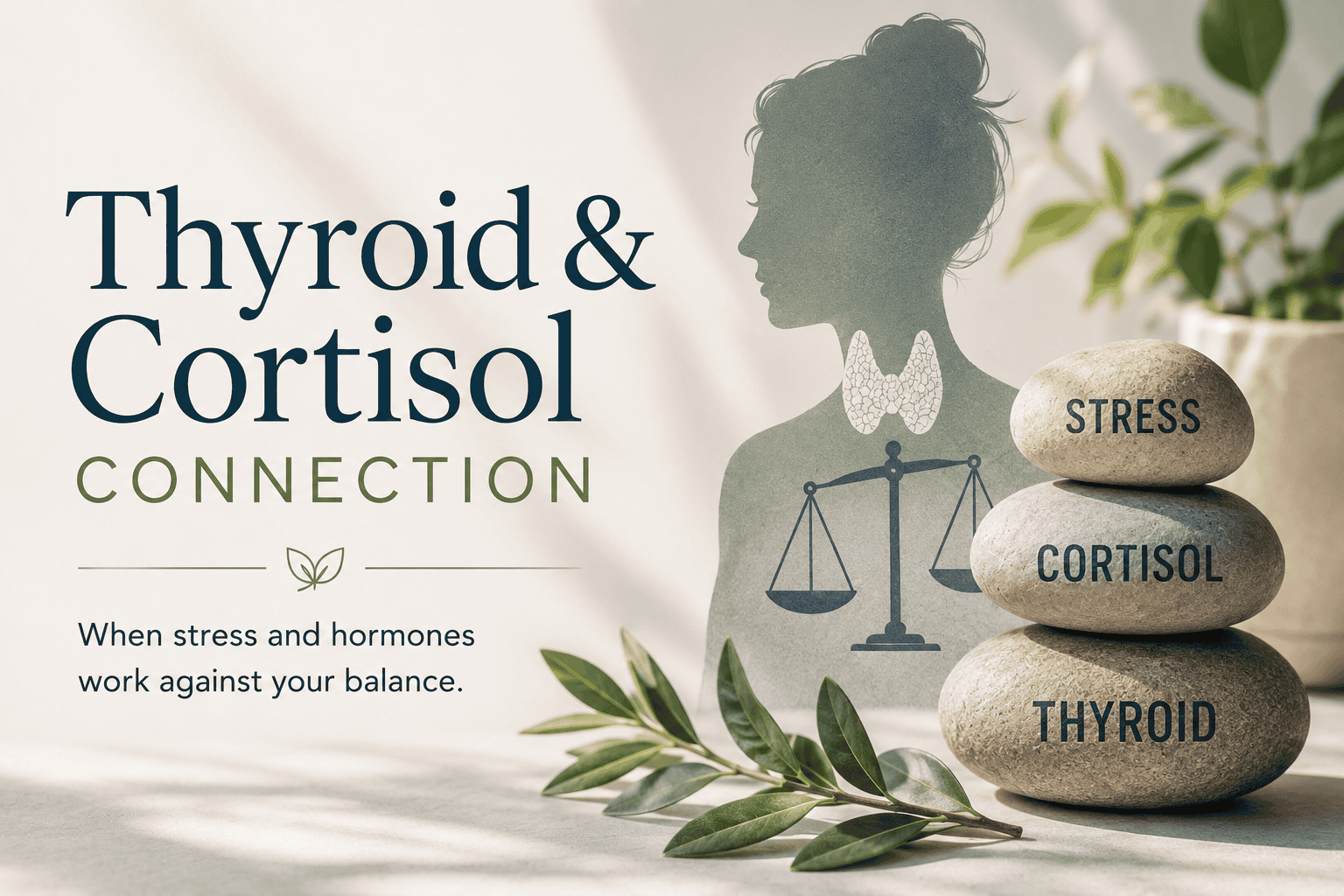
The Thyroid and Cortisol Connection No One Is Talking About
You wake up tired, but you get up anyway.
There is work to do, a family that needs you, appointments to remember, groceries to buy, bills to pay, aging parents who may need more of your attention, children or grandchildren who still need you, texts you haven’t answered, emails waiting for you, and a house that somehow never takes care of itself.
So you keep going. Women are very good at this every single day.
We can function for an amazingly long time while feeling absolutely exhausted.
Then somewhere after 40, many women begin noticing that the body they have pushed for years doesn’t bounce back quite as easily.
Sleep changes. Weight begins accumulating around the middle. Energy disappears in the afternoon. Anxiety may creep in. You feel tired at night but somehow can’t shut your brain off. Your hair may change. Your digestion changes. You become more sensitive to stress.
And then comes the sentence I hear so often:
“I don’t understand. I’m doing the same things I’ve always done, but my body is responding completely differently.”
This is where I want to talk about something that deserves much more attention: the thyroid and cortisol connection.
Because sometimes we become so focused on the thyroid that we forget the thyroid doesn’t operate by itself.
And sometimes we become so focused on “high cortisol” that we forget cortisol isn’t the enemy either.
The two systems communicate, and for women over 40, understanding that relationship can help make sense of symptoms that otherwise feel completely random.
BOOK YOUR APPOINTMENT: Virtual & in-person appointments
First, Cortisol Is Not a Bad Hormone
Social media has turned cortisol into the villain of women’s health.
“Cortisol face.”
“Cortisol belly.”
“Lower your cortisol.”
“Detox your cortisol.”
I think we need to back up and retink this.
You need cortisol.
Cortisol is a hormone produced by your adrenal glands, and it plays important roles in your stress response, blood pressure, blood sugar regulation, metabolism, inflammation and your sleep-wake rhythm.
You aren’t supposed to eliminate cortisol or you may become even more exhausted.
You want an appropriate cortisol rhythm.
Normally, cortisol follows a daily pattern. It is generally higher around the time you wake up and falls throughout the day, reaching lower levels at night so you can sleep.
That rhythm helps your body know when it is time to get up and go—and when it is time to slow down and sleep.
The problem is not simply “having cortisol.”
The bigger question is whether your stress-response system and daily rhythm are functioning appropriately for you.
What Does Cortisol Have to Do With Your Thyroid?
More than many women realize.
Your thyroid is part of what is known as the hypothalamic-pituitary-thyroid, or HPT, axis. Your stress response involves another communication network called the hypothalamic-pituitary-adrenal, or HPA, axis.
Notice something?
Both begin with communication involving the brain.
These systems are not operating in two separate buildings. They interact.
Research shows that glucocorticoids such as cortisol can influence thyroid regulation at several points, including signals from the hypothalamus and pituitary and the metabolism of thyroid hormones.
That does not mean everyday stress automatically “shuts down your thyroid,” as you may have heard online.
It means the relationship is biologically real and more nuanced than a catchy social media post.
And this is exactly why I like looking at the whole woman instead of one isolated hormone.
The Woman Who Is Tired but Cannot Slow Down
This is the woman I think gets missed.
She isn’t lying in bed all day. Quite the opposite. She is doing everything.
She gets everybody where they need to go. She manages the household. She works. She worries about her parents. She worries about her children. She answers everybody’s questions.
Ask her how she is doing and she says:
“I’m fine.”
But her body may be telling a different story.
She is exhausted in the morning, dependent on coffee to get moving, craving something sweet in the afternoon and suddenly wide awake when she finally gets into bed.
She may be gaining weight even though she doesn’t think she is eating more.
She may feel puffy.
Her brain doesn’t feel as sharp.
Exercise that once energized her now wipes her out.
Then menopause or perimenopause gets added to everything else.
Now she wonders:
Is this my thyroid? Is this cortisol? Is this menopause? Or am I simply getting older?
I don’t think “you’re getting older” is a very useful answer.
I want to know what changed.
Why This Can Become More Noticeable After 40
Women over 40 can find themselves in a perfect storm.
At the same time life responsibilities are often peaking, ovarian hormones may begin fluctuating during perimenopause. Sleep can become less predictable. Hot flashes or night sweats may interfere with restorative sleep. Body composition begins changing, and maintaining muscle becomes increasingly important.
Research has also found relationships between the menopausal transition, stress-related factors and cortisol patterns in some women.
Now add a thyroid issue—or Hashimoto’s—to that picture.
Suddenly it becomes very difficult to know which system is responsible for which symptom.
And sometimes that is the wrong question.
Maybe we shouldn’t be asking which one is responsible.
Maybe we should be asking how all of these systems are interacting.
Can High Cortisol Affect Thyroid Hormones?
This is one of the questions people search for constantly.
The answer requires some nuance.
Cortisol and other glucocorticoids can influence the signals involved in thyroid regulation. In states of significant cortisol excess, research has shown changes in TSH secretion and in the conversion and metabolism of thyroid hormones.
But I would be very careful with the popular internet claim that every stressed woman has “high cortisol that is blocking her thyroid.”
We cannot know that from symptoms alone.
A woman can be tired, gain weight and sleep poorly for many different reasons.
That is why I believe in testing, not guessing.
Cortisol and Thyroid Symptoms Can Look Surprisingly Similar
This is where women become understandably confused.
Imagine waking up tired, gaining abdominal weight, struggling with concentration, sleeping poorly and feeling increasingly anxious or irritable.
Those symptoms don’t come with labels attached.
Your body doesn’t say, “Today’s fatigue is cortisol, but tomorrow’s fatigue will be thyroid.”
Symptoms overlap.
Thyroid dysfunction can affect energy, temperature regulation, digestion, cognition and body weight. Stress and disturbances in the cortisol system can also influence energy, sleep, metabolism and how the body responds to everyday demands.
Perimenopause and menopause can overlap with both.
So can insulin resistance, nutrient deficiencies, poor sleep and inadequate muscle mass.
That is precisely why I don’t like guessing based on symptoms.
What About the Famous “Cortisol Belly”?
Women ask me about this all the time now because it is everywhere on social media.
There is some truth underneath the trend, but social media oversimplifies it.
True chronic cortisol excess, such as occurs in Cushing syndrome, can contribute to characteristic changes in body-fat distribution and metabolism. Everyday chronic stress can also affect sleep, appetite, eating behavior and metabolic health.
But if you have gained weight around your middle after 40, we should not automatically blame cortisol.
I also want to think about menopause, insulin and glucose, thyroid function, muscle mass, activity, sleep, nutrition and overall metabolic health.
The belly is giving us information.
Our job is to figure out what that information means for you.
This Is Why One Morning Cortisol Number Doesn’t Tell Me the Whole Story
Cortisol naturally changes throughout the day.
That is important.
A cortisol result at one point in time answers a different question from understanding someone’s daily cortisol pattern.
Depending on the person’s symptoms and circumstances, different forms of cortisol testing may be used for different purposes. In my wellness practice, I may be interested in a multi-point saliva cortisol pattern when I want to understand how cortisol is changing from morning through evening.
That is different from diagnosing an adrenal disease, which requires appropriate medical evaluation and validated diagnostic testing.
What I am interested in is the pattern.
Is cortisol appropriately higher in the morning?
Is it declining throughout the day?
What does the pattern look like later in the evening?
Does that information fit with what the woman is actually experiencing?
I don’t want a trendy diagnosis.
I want useful information.
And I Still Want the Complete Thyroid Picture
If we are investigating the thyroid and cortisol connection, I’m certainly not going to run cortisol and forget about the thyroid.
As I discussed in my previous thyroid article, I do not like relying on TSH alone when someone has persistent symptoms.
I want the appropriate thyroid picture, which may include TSH, Free T4, Free T3 and thyroid antibodies—especially TPO and thyroglobulin antibodies when Hashimoto’s is a concern.
In my functional approach, I also interpret those numbers in the context of symptoms, history and the rest of the person’s metabolic picture rather than asking only whether a result has crossed a conventional laboratory cutoff.
For TSH, I generally like to see approximately 1–2 mIU/L in context, while recognizing that this is a functional target I use rather than a universal medical diagnostic range.
Then I want to step back and look at the woman.
Because she is much more than four thyroid numbers.
Sometimes the Tests That Explain the Symptoms Aren’t Thyroid Tests
This is another reason I love comprehensive testing.
If a woman is exhausted and gaining weight, thyroid and cortisol may be pieces of the puzzle—but what if her fasting insulin is elevated?
What if ferritin is low?
What if B12 or another nutrient is inadequate?
What if she has very little muscle mass?
What if poor sleep is affecting her entire metabolic picture?
What if menopause-related hormonal changes are contributing?
What if several of these are happening at once?
This is where a more comprehensive evaluation can finally create that “Ah-ha!” moment so many women are looking for.
Instead of another guess, we begin collecting clues.
Your Body May Be Asking You to Stop Running on Empty
I think women need to hear this.
You cannot spend decades pouring into everybody else and expect your body never to ask for something in return.
Many women have spent their adult lives taking care of children, spouses, parents, careers, homes, businesses and everyone else’s emergencies.
We eat standing up.
We answer emails while eating dinner.
We stay up late because nighttime is finally “our time.”
We wake up exhausted and drink more coffee.
Then we wonder why our bodies aren’t responding the way they did at 30.
This doesn’t mean stress caused your thyroid condition.
And it certainly doesn’t mean your symptoms are “just stress.”
It means stress physiology deserves a seat at the table when we are trying to understand the whole picture.
You Don’t Need Another Quick Fix. You Need Your Story Put Together.
This is where my approach is different.
I don’t want to look at a tired woman over 40 and immediately give her a supplement for cortisol.
I don’t want to blame everything on menopause.
And I don’t want to look at one TSH result and decide the thyroid conversation is over.
I want to know her.
When did she stop feeling like herself?
What was happening in her life?
How is she sleeping?
When did the weight change?
What does her thyroid testing actually show?
What is happening with her hormones?
What does her cortisol pattern look like when testing is appropriate?
How is her blood sugar?
What is her nutritional status?
How much muscle does she have?
What has her body been trying to tell her?
That is when the pieces begin coming together.
Ready to Understand Your Thyroid and Cortisol Connection?
If you are over 40 and struggling with fatigue, stubborn weight, poor sleep, brain fog, feeling wired but tired, thyroid symptoms or simply feeling like your body has changed, you don’t have to keep guessing.
At Nutritionally Yours, I take the time to look at the bigger picture. Depending on your individual needs, we can explore thyroid markers, thyroid antibodies, hormones, cortisol patterns, metabolic health, nutrition and other factors that may be contributing to how you feel.
I work with clients in person in Alpharetta, Georgia, serving women throughout Alpharetta, Roswell, Johns Creek, Milton, Cumming and the greater Atlanta area, as well as virtually throughout the United States.
You have spent years taking care of everyone else.
Maybe it is time to understand what your body has been asking for.
AUTHOR: Alane M Wincek, ND, CNC
Nutritionally Yours Health and Wellness Center, Atlanta, GA